You bought the tools. You trained the people. Now what?
The Problem
The technology works. The organization stalls.
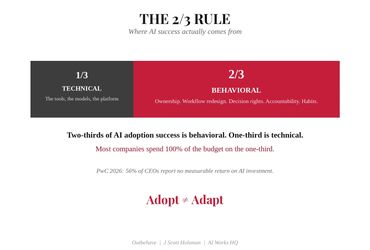
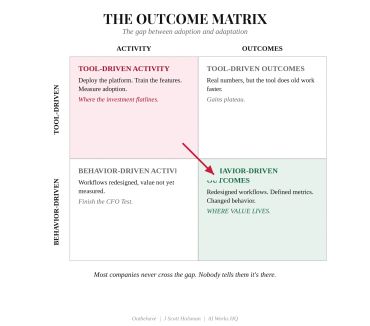
Most companies treat AI like a purchase. Buy the licenses. Train on the features. Launch the pilot. Then watch adoption flatten, because nobody redesigned how the work actually gets done. That is not a technology problem. It is a behavior problem. AI adoption is two-thirds behavioral and one-third technical. That is the 2/3 Rule, and it is the foundation of everything in this book.

Who It's For
Written for the people who answer for the spend.
For leadership teams that bought the tools, trained the people, and still cannot explain what changed. CEOs. COOs. CHROs. PE operating partners and board members who need the number to show up.
What's Inside
Part One: The Fable
A VP of HR inherits a $200,000 AI initiative that went nowhere. An outside operator walks the plant floor, asks better questions, and rebuilds it from the work up. You watch a stalled rollout become a working operating model, one decision at a time. Here is how it opens.
PROLOGUE: THE BALLROOM
Everyone in the room was nodding. Nobody was raising their hand.
Rachel Torres sat in the fourth row of a ballroom at the Fairmont, halfway through what the program called "AI and the Future of the HR Function." The speaker was polished. The slides were clean. The audience consisted of a thousand HR executives who'd paid good money to be here, and every one of them looked like they understood exactly what was being said.
Rachel didn't.
Not entirely, or at least not in the way that mattered. She understood the words because she'd heard them before at board meetings, in vendor pitches, in LinkedIn posts she'd scrolled past at midnight when she should've been sleeping. Transformation. Integration. Adoption at scale. The language of AI had become background noise, like hold music on the phone. You heard it without listening.
The speaker clicked to a new slide. A pyramid with four layers. Something about maturity models.
"The organizations that are winning," he said, "are the ones that moved past experimentation six months ago."
Rachel wrote that down. Then she looked at what she'd written and realized she didn't know what it meant. Moved past experimentation to what? Her company had four hundred people using Copilot. Or, more accurately, four hundred people who'd been trained on Copilot six months ago. But she'd seen the most recent usage reports. A third of them hadn't logged in to the tool since the first week.
She didn't raise her hand to ask the question.
Nobody did.
A specific kind of silence settled over the room full of professionals who were all pretending to be further along than they were. It wasn't uncomfortable, exactly, but practiced. It was the silence of people who'd learned that asking the wrong question in public costs more than not asking at all.
Rachel had spent fourteen years in HR. Seven as a generalist, four in talent development, three as a director. Eight months ago, she'd been promoted to Vice President of Human Resources at Grayton Manufacturing, a $480 million industrial company with fifteen hundred employees across four locations in three states. The promotion came with a corner office, a team of eleven, and a mandate she hadn't asked for:
"Figure out AI for us."
That's how the CEO had said it. Not in a meeting. Not in a memo. In the hallway, coffee in hand, on his way to the plant for a tour, like he was asking her to look into a new benefits vendor. "Rachel, you're smart. You're young. Figure out AI for us. Work with Kevin in IT. He's already got some things going."
Kevin did have some things going. That was true. Kevin Park, the IT director, had been at Grayton for fifteen years, which meant he'd outlasted three HR directors, two CFOs, and one ERP migration that nearly broke the company. He'd spent four months evaluating platforms, negotiating a Microsoft licensing deal, configuring the environment, and building a training program for Copilot. He'd rolled it out to all salaried employees in a two-week window. Clean deployment. Good documentation. Professional. Kevin was always professional.
And sixty days later, the whole thing had stalled.
It hadn't crashed or failed, exactly. It had stalled: Usage dropped, the help desk tickets stopped, and people went back to doing things the way they'd always done them, except now they had a Copilot icon in their taskbar that they'd learned to ignore. The $200,000 the company had spent on licensing and training had produced a three-week spike in activity and then a long, quiet flatline.
Rachel knew this because the CFO had told her. Not Kevin, the IT guy. The CFO, in last month's leadership meeting, in front of everyone.
"I need someone to explain to me," Alan Marsh had said, peering over his glasses the way he did when he already knew the answer but wanted to watch someone else find it, "what we got for two hundred thousand dollars."
Kevin had talked for six minutes about adoption rates and training completion percentages and platform capabilities.
Alan listened. Then he'd asked the same question again, slower: "But what did we get?"
Nobody answered.
The speaker at the conference was taking questions now. A woman near the front asked about change management frameworks. A man in a sport coat asked about vendor selection criteria. Someone asked about prompt engineering.
Rachel noticed what nobody was asking: What do I do when the tools have been deployed but nothing has changed?
Nobody asked how to explain to a CFO that adoption metrics don't mean the same thing as results. Nobody asked what happens when IT builds something technically excellent and the organization isn't ready for it. Nobody asked the question Rachel had been carrying around for weeks, the one she couldn't quite articulate, the one that woke her up at two in the morning:
We did everything right. Why isn't it working?
She looked around the ballroom. A thousand HR leaders. Fortune 500 CHROs in the front rows. Mid-market VPs like her in the middle. Directors and managers toward the back. All of them nodding. All of them taking notes.
All of them, she suspected, carrying some version of her question and doing exactly what she was doing, not raising their hand.
The session ended. People stood, and the networking buzz began, that particular hum at conferences as business cards are passed and small talk is made while the smell of coffee that's been sitting too long scents the air.
Rachel gathered her notebook and pen and stood near the exit, doing the thing mid-career professionals do at conferences: looking at her phone to appear busy while deciding whether to network or escape.
A woman nearby, CHRO badge, Fortune 500 company logo, caught her eye and smiled the conference smile. The one that means I'm open to talking if you're worth the next three minutes.
"Great session," the woman said.
"It was," Rachel lied.
"We just launched our third AI platform," the woman said, in the way people announce things they want you to ask about. "Enterprise-wide, for twenty-two thousand employees. We're seeing real traction in the first sixty days."
Rachel felt something familiar. The conference performance. The language of winning delivered by someone who may or may not be winning. She'd already heard four versions of this story today, companies that were crushing it, companies that were ahead of the curve, companies that had figured it out. None of them mentioned the cliff. None of them mentioned the CFO's question. None of them said the word nobody wanted to say: stalled.
"That's impressive," Rachel said. "What are you measuring?"
"Adoption rates. Feature utilization. Training completion. The engagement scores are strong."
"And the business outcomes?"
The woman's smile didn't change. But her eyes did. Just for a second. A flicker, the same flicker Rachel had seen in her own mirror. The flicker of someone who knows the question behind the question and doesn't have an answer for it.
"We're tracking toward projections," the woman said.
Which was not the same thing as results.
They exchanged business cards. Rachel knew she would never call. The woman probably knew it too. They'd both leave this conference and go back to companies where the tools were deployed and the slides were polished and the adoption curves dropped over a cliff that nobody was showing the board.
Rachel walked out of the ballroom and into the hotel lobby, where the light was different and the air was cooler and nobody was nodding.
On the flight home, Rachel opened her laptop and stared at a blank document. The cursor blinked. She was supposed to be drafting her AI update for tomorrow's call with David, the CEO. Instead, she wrote a list of things she knew were true:
We bought the tools. They're not working.
Kevin did his job. This isn't his fault.
The CEO thinks this is a technology problem. It's not.
The CFO wants a number. I don't have one.
I don't know what the right question is yet.
She looked at the list for a long time. Then she added a sixth line:
Nobody does.
The man in the seat next to her was using ChatGPT on his phone. She could see the screen, he was drafting an email, accepting each suggestion without editing, moving to the next one. The tool was doing the thinking. He was doing the tapping. He looked efficient. He looked productive. He did not look like he was thinking about anything.
Rachel closed her laptop and watched the clouds pass below. Somewhere between San Francisco and home, she made a decision she didn't fully understand yet. She was done nodding. She was going to raise her hand.
She just needed to figure out the question first.
Keep reading on Amazon.
Part Two: The Operating Manual
The frameworks behind the story, with scorecards, worked examples, and the exact sequence to run them. This is the part your team will dog-ear.
The Eight Disciplines
MINDSET
- Own Your Disruption
- Define the Outcome Before the Tool
- Sequence for Momentum
EXECUTION
4. Invest the Cognitive Surplus
5. Build Human-AI Workflows
6. Speak the Language of the Business
7. Create Multiplier Systems
TRANSFORMATION
8. Sharpen the Workforce
Skip one, and the next one breaks.
THE FRAMEWORK
Two Ways to Start
Read the book. Or reach out and bring it to your team.
Bringing this to your leadership team? The disciplines in OutBehave are the same ones behind the executive workshops and advisory work at AI Works HQ. Start with the book. We'll talk when you're ready.